
 Full Text (PDF)
Abstract
In this article, we analyze the emotions that are revealed in family conversations during visits to an aquarium, seeking to understand how emotions are related to these conversations about environmental issues. The visits of five families (17 individuals) were recorded using the point-of-view method and analyzed using Dedoose software. To identify emotions, we used emotion descriptors standardized associated with the analysis of emotional valence and arousal based on the circumplex model of affect. Using an inductive process, the data were analyzed based on two categories: (1) leisure and contemplation and (2) meaning making, relating them to remarks connected to environmental issues. This analysis revealed that the predominant emotions were positive, representing 81% of the emotional responses identified. Family conversations, often associated with moments of leisure and contemplation, were influenced by emotions, but often lacked deeper discussions about environmental issues. The collected data suggest that the visit to AquaRio may have played an important role in sparking feelings and reflections from families on environmental issues. This may be particularly relevant in promoting families’ continued interest in biodiversity and the marine environment, as positive emotions can favor the search for further knowledge and greater engagement in conservation actions that can develop over time.
Keywords
License
This is an open access article distributed under the Creative Commons Attribution License which permits unrestricted use, distribution, and reproduction in any medium, provided the original work is properly cited.
Article Type: Research Article
AQUADEMIA, Volume 10, Issue 1, 2026, Article No: ep26004
https://doi.org/10.29333/aquademia/17949
Publication date: 18 Feb 2026
Article Views: 1969
Article Downloads: 805
Open Access HTML Content Download XML References How to cite this articleHTML Content
INTRODUCTION
In the context of a growing loss of biodiversity worldwide (Secretariat of the Convention on Biological Diversity [CBD], 2020), one increasingly urgent concern is the conservation of our oceans. The decade of the ocean, designed to address critical challenges and promote marine sustainability, highlights the importance of identifying effective strategies to motivate people to become engaged in marine conservation (United Nations, Educational, Scientific and Cultural Organization—UNESCO/IOC, 2021). Studies have shown that seeing and learning about animals and nature, whether in the media, or in situ or ex situ environments, can generate understanding, interest and emotional reactions (Skibins & Sharp, 2019).
Aquariums play a significant role in this context. They can be important tools for education and awareness raising, offering people the opportunity for first-hand contact with the beauty and diversity of the underwater world. Marine animals attract people’s interest (Barash, 2014) and aquariums are spaces that receive a large number of visitors. Over 30 million people visit zoos and aquariums in Brazil every year (Center for Strategic Studies and Management [CGEE], 2019). This highlights the role of these institutions as ideal places to convey messages about marine biodiversity, as well as establishing emotional connections and actions for conservation.
A study by Ballantyne et al. (2011) shows that the experience of observing and coming into contact with wild animals in institutions such as zoos and aquariums follows a continuum that begins with
-
sensory impressions of the visit, i.e., what visitors see and hear,
-
building empathy or emotional connection,
-
cognitive reflection, and
-
the meaning making that can culminate in tangible actions for a more responsible and sustainable life.
However, we know little about what visitors feel when viewing animals in zoos and aquariums. The field of studies of animal-visitor interactions includes a modest number of studies on the effects of visitors on zoo animals (Sherwen & Hemsworth, 2019). But there is still a considerable paucity of scientific literature on how viewing animals in zoos and aquariums affects visitors (Learmonth et al., 2021), specifically its emotional impacts. Although emotions are seen as a key component for investigating the visitor experience in informal spaces (NEMO, 2021), the field lacks a more critical examination and evaluation of their impact, especially in informal science learning spaces.
The existing literature includes evidence that zoos and aquariums bring about positive emotional experiences that spark people’s sense of connection with wildlife and their interest in involvement with conservation (e.g., Luebke et al., 2016; Myers et al., 2004; Powell & Bullock, 2014; Santos et al., 2023). Luebke (2018), for instance, used questionnaires to examine how the subjective and positive experiences of adult visitors were related to the affective and empathetic capacities displayed by the animals of Brookfield Zoo (Chicago, IL, USA). The results indicate that visitors were highly interested in the exhibits and were not merely passive animal observers making thoughtful remarks about the animals and showing empathetic concerns regarding the environment and conservation.
Another study provides evidence that visitors have mixed feelings about interacting with wild animals in human-made environments. Marseille et al. (2012) examined the emotions involved in visitors’ experiences with polar bears in zoos and how these experiences related to attitudes towards conservation. The study was carried out with 30 participants through interviews in two Dutch zoos. The results pointed to positive feelings of joy and fascination when visitors saw the polar bear, especially when it was active, and negative feelings of sadness and worry in remarks alluding to the species being outside its natural habitat and presenting stereotyped behavior. Regarding conservation, the authors show that the majority of visitors (n = 22) felt concerned about the loss of the species’ habitat, while a smaller number, albeit still the majority (n = 18), indicated that they felt responsible for the animals’ well-being, specifically considering their own contribution to greenhouse gas emissions, and were willing to act for conservation, up to a point.
Regarding visitors’ perceptions of animals, studies demonstrate that people who have positive perceptions of animal welfare, i.e., visitors whose remarks indicate that the animals are happy or well-treated and cared for, are more likely to return and are also more aware and informed about wildlife conservation (Anderson et al., 2003; Povey & Rios, 2002; Roe et al., 2014). Young et al. (2018) argue that it is sometimes difficult to observe emotions in animals, so people mostly attribute emotions to the vitality effect, i.e., the animal’s arousal patterns and qualities, trying to understand their feelings. In this vein, Callahan et al. (2021) analyzed public perceptions of wild species in relation to animal emotion and cognition. Through an online survey of 2,342 participants from the US, the authors investigated perceptions regarding 36 species. The results indicate that participants were more likely to attribute cognitive characteristics to animals, followed by emotional traits. Another result highlighted by the authors shows that people consider species that are phylogenetically closer to humans to be more intelligent and more capable of feeling emotions. Thus, mammals ranked highest in the study, followed by birds, reptiles, amphibians and fish.
Taken together, these studies support the idea that informal science learning experiences trigger a variety of emotions, be they positive, such as awe, fascination and pleasure, or negative ones, i.e., worry, frustration and anxiety, and that they can interfere with visitors’ behaviors, attitudes towards conservation and empathy for animals in ways that we are only just beginning to understand (Ballantyne et al., 2011; Krogh-Jespersen et al., 2020; Myers et al., 2004; Price et al., 2021; Scalfi et al., 2024). With a view to furthering studies in the field of emotion in informal environments, this article analyzes the emotions experienced by families on a visit to an aquarium. Specifically, we seek to answer the following questions:
-
What emotions are expressed in conversations between families visiting an aquarium?
-
How are emotions related to environmental issues in family conversations and interactions?
Theoretical Framework
Emotions can be conceptualized in different ways. To put this in context, we have identified three perspectives that stand out in the field.
-
Naturalistic, which sees the phenomenon of emotions as the result of biological processes and is therefore universal and innate to all subjects, regardless of their culture or territory (Ekman, 1993; Plutchik, 1962).
-
Constructivist, based on the notion that emotions are the result of the social, cultural, and historical relationships to which they belong, thus having specificities in terms of their forms of expression, depending on their context (Ahmed, 2014; Barrett, 2017).
-
Integrated, which works with the understanding that emotions have a biological, social, historical and cultural dimension (Gu et al., 2019; Hofmann & Doan, 2018).
In this study, we analyze emotions according to the third perspective, seeing emotions as a biological aspect, albeit socially constructed, in response to important events in the environment. Thus, emotions help to guide our thoughts and actions and help us to achieve our goals (Lang et al., 1998).
With regard to how to measure emotional states, we highlight two different perspectives: discrete and dimensional. Discrete emotion theories were inspired by Darwin (1965). Researchers have proposed a set of basic emotions from which emotional experiences are built (Ekman, 1992). From the perspective of discrete emotions, each emotion corresponds to unique components in experience, physiology and behavior (Ekman, 1999; Panksepp 2007). For example, the emotion of anger is associated with an increase in heart rate, muscle tension and specific facial expressions, such as frowning and fist clenching. Each of these elements contributes to the unique emotional experience of anger, according to the discrete emotions view.
Emotions can also be contextualized from a dimensional perspective in which each emotion is organized into two basic dimensions along a continuum: valence (unpleasant to pleasant) and arousal/activation (Russell, 2003; Russell & Barrett, 1999). Thus, any emotion can be described in terms of its valence and activation, referred to as “core affect”. For example, joy is often considered an emotion that has high valence (very pleasant) and high activation (high arousal). Sadness, on the other hand, can be described as an emotion with low valence (unpleasant) and low activation (low arousal). As people may differ widely in emotional granularity, measures of core affect can provide a more reliable measure of emotional experiences (Barrett, 2006).
Knowing that people’s behavior in an environment is influenced by emotions and that emotional states are expressed and can be inferred in actions and conversations, in this study we used the circumplex model (Russell, 2003; Russell & Barrett 1999) to investigate families’ experiences.
METHODOLOGY
The study was conducted within the framework of the National Institute of Public Communication of Science and Technology, which aims to understand the experiences, learning and meanings created by different audiences in relation to the activities offered in scientific-cultural spaces (Massarani et al 2019a, 2019b, 2022).
In this specific study we adopted an exploratory and qualitative approach, using audiovisual recordings to make sense of families’ emotional experience when visiting an aquarium. This project was approved by the Joaquim Venâncio Polytechnic School Research Ethics Committee (EPSJV/Fiocruz), case number 466/2012, and under National Health Council/Ministry of Health Operational Norm n°001/2013.
AquaRio
Founded in 2016 in the Port Zone of Rio de Janeiro, AquaRio is a private, modern and multifunctional space for education, research, conservation, leisure, entertainment and culture. According to World Association of Zoos and Aquariums (2021), AquaRio is the largest marine aquarium in South America. The building covers an area of 26,000 square meters and has five floors, three of which are open to the public. Until 1980, this was the site of a cold storage space belonging to the Brazilian Warehousing Company (CIBRAZÉM), which is part of the National Food Supply Company (CONAB) (Rey, 2019). When the harbor area was rebuilt to host the 2016 Olympic Games, in an urban operation known as Porto Maravilha, the Rio de Janeiro Marine Aquarium Museum Institute (IMAM), chaired by Marcelo Szpilman, won the bid for the land from the city council for 50 years. The aquarium project was built with funds from the private sector (Aquário Marinho do Rio de Janeiro, 2023).
AquaRio currently has 28 aquarium tanks with approximately 4.5 million liters of water that are home to 5,000 animals including 350 species of fish, invertebrates, algae and aquatic plants (World Association of Zoos and Aquariums, 2021). One of its attractions includes a seven-meter-high tunnel that runs inside the tank, allowing visitors to walk through it to observe fish such as sharks and rays. AquaRio has signs and information boards describing the species, as well as other educational contents.
The public is diversified and includes spontaneous groups of local visitors, tourists and schoolchildren. It should be noted that, in partnership with Rio de Janeiro City Hall, municipal schools are entitled to free entry by appointment. In 2022, the number of visitors over the year reached 5,000,000 (Aquário Marinho do Rio de Janeiro, 2023). Tickets for adults cost R$150,00 (equivalent to 47 US dollars). The Museum of Tomorrow and the Rio Art Museum are situated close to AquaRio.
Procedures and Participants
In our study, we defined family groups as families composed of members who are biologically related or that are considered to be part of the family (Briseño-Garzón & Anderson, 2012), requiring the existence of some kind of relationship of upbringing or responsibility for the children.
For the data collection, families arriving at AquaRio were approached randomly by the research team and invited to take part in the study. As a criterion for participation, the groups had to have at least one adult and one child (aged between 7 and 12) and a maximum of five members, to enable fuss-free recording of the audiovisual data. After agreeing to take part in the study, the groups were handed a Free and Informed Consent Form, in accordance with ethical research procedures. Five families refused to take part in the study. Among the reasons given were lack of time or a reluctance to use a camera or sign the consent form.
A Zoom Q3HD video recorder was used by a child in each family (and chosen by the group itself), attached to a lanyard around their neck, to record family interactions. This method is known as point-of-view and enables the recording of extensive data of participants interacting with all kinds of elements in the environment (Burris, 2017) (Figure 1). For instance, the camera records participants talking, reading signs, using touchscreens and playing with practical components.
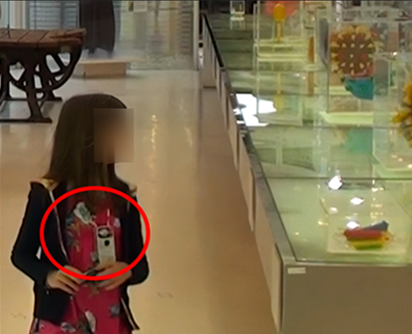
It was decided the visits would begin at the Plankton Station, located at the start of the visitors’ route and equipped with an educational booth and an explainer. From this point the families were free to roam at will until the end, where the researchers switched off the camera and took it back. This process took place between 16 and 24 January 2018, on weekdays and one weekend during the school vacations. The study included 17 individuals divided into five family groups (G1-5). Ten of the participants were adults (9 ♀ and 1♂) and seven were children (1♀and 6♂).
Analyzing Data
The videos were uploaded to Dedoose, a qualitative data analysis software. All significant conversation segments, similar to those proposed by Ash et al. (2008), were transcribed. In short, events were considered significant if they:
-
had a clear beginning, middle, and end,
-
contained spoken content related to the exhibition,
-
contained conversations between participants or were carried out by a speaker with him/herself or with an imagined individual, and
-
contained linguistic emotional descriptors (spoken or gestural).
Coding was then done directly on the video, considering gestures, tone of voice, movements, body position, gaze, touch and other paralinguistic markers of emotion. To this end, the emotion descriptors proposed by the emotion annotation and representation language (Douglas-Cowie et al., 2007; Schröder et al., 2006) and wheel of emotion (Plutchik, 2001), were employed as references, and a total of 63 emotions were recorded in this study.
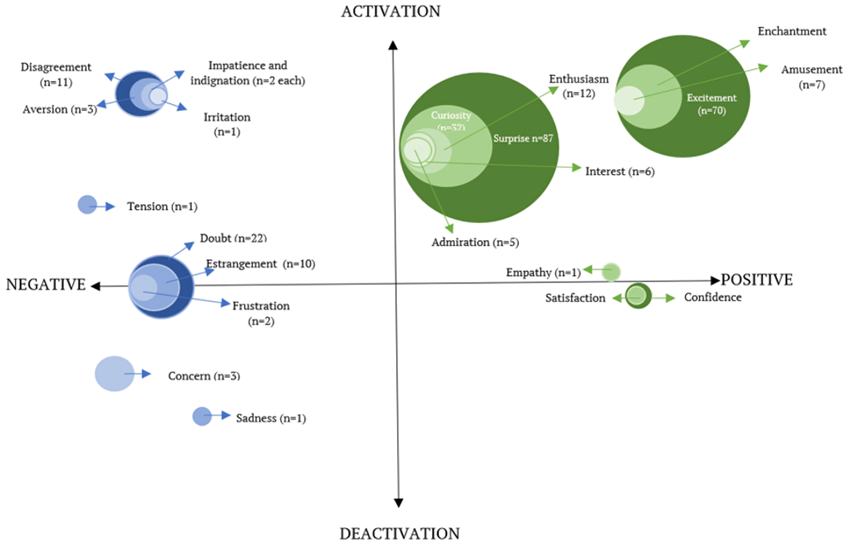
After the emotions were identified using the above-mentioned descriptors (Table 1), they were classified according to their valence (positive and negative) and arousal levels (low or high), based on the core affect model (Russell, 2003) and the circumplex model (Figure 2).
Table 1. List of emotion descriptors adapted from the HUMAINE/EARL protocols by Rowe et al. (2023)
|

After encoding and classifying the emotions, the data were regrouped using axial coding (Glaser, 1978). Based on an inductive process, two categories emerged focusing on significant events:
-
Leisure and contemplation: Emotions associated with the perceived characteristics of animals, such as appearance, beauty, size and color, in a generic way.
-
Meaning making: Emotions that occur when families or their individual members try to make sense of new information conveyed by the exhibits. This process is shaped by the families’ cultural and social experiences.
RESULTS
What Emotions Were Identified?
In a total of 189 minutes and 25 seconds of footage, 51 significant events were identified representing approximately 14% of the total time (equivalent to 26 minutes and 21 seconds). For these significant events, 22 emotion descriptors were used.
Figure 3 shows the distribution of emotional responses based on a model adapted by Rowe et al. (2023) from the structure proposed by Russell (2003) and Rappolt-Schlichtmann et al. (2017). Larger numbers of descriptors were found to be related to emotions with positive valence and high activation, with 243 occurrences, while descriptors referring to emotions with positive valence and low activation occurred in three situations. On the other hand, descriptors linked to emotions with negative valence and high activation were recorded in 54 instances, while those associated with emotions with negative valence and low activation were identified in four situations. Thus, the positive categories reactive (surprise, curiosity, enthusiasm, interest, and admiration), positive and lively (excitement, enchantment, and amusement) were the most prevalent. The categories negative thoughts (doubt, estrangement, and frustration), negative and strong (disagreement, aversion, impatience, indignation, and irritation) were less frequent and fell into the negative/active quadrant. For a deeper understanding of how these emotions manifested in the families’ experiences, practical examples are given in the following sub-item.
How Were Emotions Present in the Families’ Visiting Experience?
The results of the emotions found in the three categories focusing on significant events were proposed for a more in-depth qualitative analysis of those emotions. For this analysis, each emotion descriptor was counted only once within the same significant event; therefore, the ‘n’ of emotions does not correspond to the occurrences presented in the total footage time analyzed, as indicated in Figure 4.

Of the 51 significant events, 19 fell within the category of leisure and contemplation and 32 in meaning making. In leisure and contemplation, nine positive emotion descriptors and six negative emotion descriptors were identified, with the positive emotions standing out: excitement (n = 16) and surprise (n = 14). In meaning making, eight were positive and five negative. Of these, curiosity (n = 20) was the most recurrent, followed by surprise (n = 18), excitement (n = 14), and doubt (n = 10).
An analysis of the families’ dialogues in terms of the moments of meaning making clearly indicates that the emotions of curiosity and doubt played a constructive role in the conversations. Curiosity indicated a desire to understand more about a topic or situation. It was an emotion that instigated children and adults to ask questions and explore new ideas. Doubt, on the other hand, appeared recurrently when family members were faced with conflicting information and uncertainty. Doubt was identified in the significant events as an impulse to seek more information or to deepen the discussion. Here are some examples:
Example 1. Rock fish pond
C1: That’s cool, it’s a fish! [SURPRISE]
A1: It’s a stonefish (.) It’s mimetic (.) Do you know what mimetic means? (0.2)
Camouflaged (.) You look at it and don’t realize it’s a fish.
C1: But is it thin? [DOUBT; ESTRANGEMENT]
A1: This one is (.) That one’s a big one.
C1: [laughs] It’s because one is like me and the other one is like Dad!
A1: Oh!
Example 2. Tank containing moray eels
C1: Look at its eyes. The eyes look like --
A1: It’s a moray eel. Moray eels are fish [inaudible].
C2: Those animals are moray eels? [CURIOSITY; DOUBT]
A1: That creature hiding here. See?
A2: That thing’s [inaudible] hurts like hell. They say it’s [inaudible].
C1: I’m actually scared. [TENSION]
C2: What’s that, Mum?
A1: It can give you a fever. Give you a fever. Look at the moray eel. You know who [inaudible] by a moray eel?
C1: No.
A1: Uncle Denis.
A3: Does it have only one eye? [DOUBT]
C1: Over there, Mum. They’re [inaudible], right?
A1: No, that’s a different kind of fish. Now look over there. Among the stones, see?
Two moray eels. And then (.) do you know how they swim? [DISAGREEMENT]
C1: No.
A1: Like a snake, like this. In Arraial do Cabo there’s a huge one that’s become famous.
C1: Which one? [CURIOSITY]
A1: I don’t know its name. It’s an eel.
Example 3. Digital interactive panel (hammerhead shark)
C1: When it’s small it’s only 50 centimeters long? [CURIOSITY; DOUBT]
A1: That’s the one we saw.
C1: Later it reaches 33 centimeters in length.
Ma: Three meters.
A1: Three meters. One hundred and fifty kilos.
C1: Holy shit! [SURPRISE; EXCITEMENT]
Ma: The biggest ones can reach five meters in length. Really big.
A1: Massive! [SURPRISE]
Ma: Bigger than this wall here.
C1: Seriously? [SURPRISE]
Ma: Seriously.
A1: [inaudible] These ones here are still small. They’re young.
Example 4. Panel at the entrance to the exhibition
C1: Are there any lionfish? [CURIOSITY]
Ma: Huh?
C1: There are lionfish here.
Ma: There are some really cool fish. There are sharks, there are rays. You’ll see jellyfish that glow in the dark.
C1: Do jellyfish glow in the dark? [CURIOSITY; DOUBT]
Ma: They do. You’ll love it, Heitor. There’s a massive shark like this one, over two meters long, and you’ll see it passing this close above your head.
A1: So what?
C1: Cool! [EXCITEMENT]
Ma: [laughs]
C1: Let’s go! I want to see it right away! [IMPATIENCE; EXCITEMENT]
As can be seen in the above examples, positive and negative emotions occur simultaneously in the same significant event. Doubt, classified as a negative emotion, was not related at any time to negative aspects of the families’ experience. In all the examples, doubt reflected the participants’ involvement in constructing meaning, which was qualified by Evans et al. (2017) and Rappolt-Schlictman et al. (2017) as a productive struggle. In the transcript of Example 1, in addition to the adult’s explanation of mimicry, the child wants to know more about the species: “But is it thin?” In example 2, the child wants to be sure of what it sees: C2: “Those animals are moray eels? “Likewise, in example 3, in which the child tries to confirm the information: “When it’s small it’s only fifty centimeters long?” In many instances, curiosity and doubt were identified sequentially (examples 2, 3, and 4). Curiosity, also present in moments of surprise, led to a lot of content being shared and understood between the adult and child.
The examples also reinforce the families’ meaning making by bringing information and knowledge from their daily lives to bear on what they were viewing. For example, when the child associates the size of the fish with him and his father (example 1), or when the mother refers to a moray eel that became known in the city of Arraial do Cabo for its size (example 2).
In the leisure and contemplation bracket there is a strong expression of positive emotions with high activation, categorized as positive and lively, followed by the reactive category (surprise). These emotions indicate that the families’ experience was pleasant and enjoyable. The emotion of excitement, for instance, demonstrates that the families were enthusiastic and felt energized during their visit. The emotion of surprise added an element of novelty to the activities they were involved in, as visitors came across unexpected marine animals and interesting behaviors. Let’s look at some examples.
Example 5. Tank with clownfish
C1: Oh my God, they’re clownfish. They’re clownfish! Take a look at that!
LOOK AT THIS ONE AUNTIE! That one. Black and white. [SURPRISE; EXCITEMENT]
A1: [inaudible]
C1: There’s some there too.
A1: Look how pretty they are, guys! [ADMIRATION]
C1: Look at those clownfish! [ENTHUSIASM]
Group 6. Tank with sharks
C1: Look at that! See its teeth! [SURPRISE; EXCITEMENT]
A2: Take a look at its teeth! [SURPRISE]
C1: Look, it’s got a lot of teeth! [SURPRISE]
A1: Does it have to keep its mouth open the whole time?
C1: He wants to show off, got it? Man, so many teeth! WOW, there’s a big fat one over there! [SURPRISE; EXCITEMENT]
A1: There’s another one there.
C2: Ah... [EXCITEMENT]
C1: There’s a fat guy over there. [SURPRISE; EXCITEMENT]
C2: Just look at that [inaudible]. There’s a big fish coming our way.
C1: Yeah.
C2: A shark --
C1: Jeez! [looks]
C2: CRIKEY, A SHARK!
C1: There’s another one over there!
C2: A shark! [SURPRISE; EXCITEMENT]
C1: Dude, it’s massive, right? [SURPRISE]
C2: Look at that shark! [SURPRISE; EXCITEMENT]
Example 7. Tank containing rays
A1: Look at the baby [inaudible]. It’s a baby.
C1: Awww, how cute! [ENCHANTMENT]
A2: Take a look at this one, it’s right above us. [EXCITEMENT].
C1: I was about to take a picture of the wrong one. What a darling! (.) Take a look at this ray. It’s very beautiful. [ENCHANTMENT; ADMIRATION]
Example 8. Tank with fish
C1: Dad, look at this one, it’s got a bug stuck to it. [EXCITEMENT; PERPLEXITY]
A2: [inaudible]
C2: I don’t know.
A1: [Inaudible] that over there is a little egg. Like the ones over there, see?
C1: Are those eggs? [DOUBT]
A1: They’re not.
C1: Things
A1: They’re little shellfish. Shellfish.
C1: Amazing! So beautiful! [SURPRISE; ADMIRATION].
A2: Look how gorgeous this one is. [ADMIRATION; EXCITEMENT]
C1: Over there. It’s coming out! [EXCITEMENT]
A2: Look at that one. Look at that one!
C1: It’s coming out. It’s coming out! There, see its face. So ugly, jeez! How ugly! [EXCITEMENT; SURPRISE; AVERSION]
Example 9. Observing tank XXX
C1: What’s that? [CURIOSITY]
A1: It’s the fish that burrow in the sand
C1: Oh. But that one looks like that Pokemon! [SURPRISE; EXCITEMENT]
A1: [laughs] [FUN]
In example 5, the visitors expressed surprise and excitement on seeing the clownfish. Similar emotions are observed in example 9, when the child, arriving with an initial attitude of curiosity that is encouraged by the adult who accompanies them is surprised and enchantment (excitement) by the behavior of the fish burying itself in the sand. These reactions can be ascribed to the association with popular animation movie characters, which frequently include clownfish, and to the role that media such as cartoons play in children’s knowledge of the species. Another significant event was the naming of the clownfish as a character from a Pixey/Disney film, in the following excerpt: “A1: Look at Nemo over there! Let’s go see Nemo.(.) There are no Nemos in Brazil/C1: Nemo, really? “ [INTEREST]. Surprise was also a recurring emotion when viewing sharks, particularly when visitors noticed the razor-sharp teeth of these marine predators (example 6). The element of novelty and unpredictability associated with the presence of sharks in the aquarium contributed to the expression of excitement.
Meanwhile, the visit to the ray tank (example 7) led to enchantment and admiration when visitors saw the rays swimming, as well as a special affection for the young rays in the tank. Moreover, it is interesting to note that emotions of surprise, excitement and estrangment were also expressed when something unexpected was seen, such as during the observation of eggs stuck to the glass.
The episodes strengthen the potential for a visit to an aquarium being a memorable experience for everyone involved. These varied emotional experiences, which included excitement, curiosity, surprise, doubt, etc., demonstrate that interactions with marine life can deeply enrich a visitor’s journey, making the visit not only educational but also emotionally meaningful. This understanding highlights the importance of providing enriching experiences in aquariums that not only elicit wonder but also inspire a deeper connection with the marine world and the need for its preservation. However, one of the questions that guided this study involved environmental issues, aiming to identify the emotions that stand out in these conversations and interactions. The results identified are presented below.
How Environmental Issues Came up in Family Conversations and Interactions
We found that environmental issues were a topic that appeared discretely in the families’ conversations and interactions (in eight of the 51 significant events). However, these issues proved to be crucial for visitors to feel a closer connection with the species, reflect on their behavior and on the environmental impacts affecting the oceans. In the categories analyzed, environmental issues were directly associated with significant events related to the meaning making. With regard to the valence of the emotions associated with environmental issues, we found that these were mostly negative, with emotions of concern, indignation and disagreement occurring in the dialogues. Let’s look at a few other examples:
Example 10. Observing the fish
A1: What a cutie that yellow one! [EXCITEMENT; ENTHUSIASM]
C1: Look at this little black one here. Here, see. Take a look at these orange fish! [EXCITEMENT]
A1: That one on the rock, that ugly thing. See it? With white spots. [AVERSION]
A3: Oh...
A1: The white-spotted one. Oh, the yellow one is a beauty [ADMIRATION].
A3: It’s just the one, right?
A1: Yeah, that one over there, I think it’s the only one of its kind. [CURIOSITY, DOUBT]
A3: And it stays still.
C1: Look, there’s another one! [SURPRISE]
A3: You see why we need to protect them in every way and conserve the sea. So we can maintain the species. You guys are the ones who can change that. D’you see, baby? [CONCERN]
C1: Look at that one, auntie! [EXCITEMENT]
A3: Wow, just look at that. [ENCHANTMENT]
A1: My God, take a peek! [SURPRISE]
Example 11. Observing a tank (unidentified)
A1: Let’s go. That coral didn’t come from here, Rio.
C1: No? [INTEREST]
A1: It arrived on the hull of a ship and invaded.
C1: Oh yeah. That thing that makes you feel sick. [EXCITEMENT]
A1: No, that’s not it. It invaded [our sea], it didn’t come from here. [DISAGREEMENT]
C1: It’s poisonous! [EXCITEMENT]
A1: It’s not from here. (.) It came here. It’s not poisonous. That’s not it. [DISAGREEMENT]
C1: Is it alive? [DOUBT]
A1: But that means it’s taking the place of a coral that’s ours.
Example 12. Coastal species tank
C1: Wow, that’s so cool.
A2: Take a look over there.
C1: It’s a shame they kill themselves. They die easily, don’t they?
A1: Huh?
C1: With all the litter everyone throws in. [INDIGNATION]
A1: Yeah. Look at the moray eel.
A2: Snake.
C1: It’s a “mututuca”. [DISAGREEMENT]
Example 13. Looking at a tank (unidentified)
C1: I think it’s the fish that die the most because of waste. I think.
A1: What?
C1: I think --
A1: -- What? [INTERESTED]
C1: Those fish are the ones that die the most due to this.
A1: That’s right. Due to pollution.
C1: People eat stuff and don’t put their rubbish in the bin. They dump it where it shouldn’t be left. [INDIGNATION]
In the first episode (example 10), the participants show emotions such as excitement and enthusiasm when observing the beauty of the colorful fish. However, the adult’s expression of concern about the importance of conserving the oceans so that we can continue to observe marine beauty stands out, highlighting the role children can play to effect these changes. In example 11, when observing an invading coral, the child shows excitement and interest, while the adult looks for the best way to offer an explanation. The adult disagrees with the child’s statements and shows the child that the species of coral they were looking at is harmful to native fauna.
Four episodes focused on the issue of marine pollution and how it affected animals. Two of them are shown above (example 12 and example 13). In the first one (example 12), the child states in a tone of indignation that the animals are dying because of all the rubbish people dump in the sea, and in the second one (example 13) the child says that he thinks the death of the fish is caused mostly by waste matter, in other words pollution. This is because, in his opinion, people don’t discard garbage in the right place. The other two examples follow the same line of reasoning. We have highlighted one of these examples (example 14), stressing the presence of the explainer, who in this study was located at specific points in AquaRio.
Example 14. Viewing the turtle skeleton
A1: A turtle skeleton.
Ma: The skeleton is basically all bone, see? Like this. It’s closer to the top of the turtle’s skeleton, which we call the shell. It’s as though it was our ribs, that are back here like this, but throughout its life they grew together, throughout evolution.
A1: Turn this [inaudible] to you.
Ma: [laughs]
A1: See, is this one lower down? [DOUBT]
Ma: No, it’s higher up.
A1: Oh, ok.
Ma: Here it is, ready.
A1: See?
Ma: But did you know that turtles are dying out?
C1: I didn’t.
Ma: Because of the waste.
A1: Do you know what makes a turtle die? It’s if you don’t let it come up from the bottom of the sea.
Ma: Of course.
A1: The turtle panics and drowns.
Ma: Of course.
C1: Holy shit! [SURPRISE]
A1: It’s true.
Ma: Turtles have lungs, so they breathe.
A1: You can’t. Look at the pufferfish! [SURPRISE]
Ma: And also, turtles die because of plastic bags. Or because they eat some species of jellyfish.
C1: AMAZING!
As can be seen in example 14, the conversation becomes more serious when the explainer mentions that turtles are dying due to pollution and waste matter in the sea. This surprises the visitors, who use terms such as “holy shit!” to express astonishment and disbelief.
Overall, these examples illustrate how emotions play a fundamental role in the way visitors interact and respond to information about environmental issues during their visit to the aquarium, and how conversations relate to the meaning making. This shows that environmental awareness and engagement in discussions about environmental conservation can be strengthened through the educational approach in environments such as AquaRio, providing a solid basis for future actions and reflections in favor of the sustainability and conservation of marine ecosystems.
DISCUSSION
In this study, our aim was to analyze the emotions experienced by families on a visit to an aquarium and to understand how emotions are related to family conversations about environmental issues.
Our findings indicate that the emotions experienced by the families were mostly positive, accounting for 81 per cent of all emotions. This result is in line with previous studies carried out in both zoos and aquariums, in which visitors showed mainly positive emotions during their visits (Clayton et al., 2009, 2011; Myers et al., 2004). In the specific context of aquariums, Santos et al. (2023) obtained similar results when they analyzed interactions between humans and fauna through participant observation and questionnaires during a visit to the Marine Education Aquarium at the University of Georgia, Savannah (USA). Our results indicate that more positive emotional responses were shown by the participants through expressions such as smiles, laughter, raising brows, showing surprise, and by expressions of enthusiasm, joy and curiosity upon seeing the animals.
These results confirm the value of experiences in the aquarium environment in terms of providing pleasant moments for families, as we can see from the conversations in the “leisure and contemplation” category of this study, which underlined emotions of excitement and surprise. In this category, we highlight two important results. The first refers to a factor that brought children closer to animals with emotions of surprise, excitement and interest and was related to the identification of species with characters from films, cartoons or animations. For Skibins and Sharp (2019), watching animals on screens provides people, whether children or adults, with opportunities to learn about animals and nature. In addition, we found that recognizing the species of a character proved to be a factor in positive emotional responses.
Another result concerns animal characteristics and public perception. Studies have provided evidence that animal characteristics are important in shaping visitors’ emotional responses (Moss & Esson, 2010; Myers et al., 2004; Rigney & Callanan, 2011). In this study, the focus is on an aquarium environment, where fish and invertebrate animals are the attraction. In general, studies indicate that classes of animals such as fish, insects, invertebrates and reptiles frequently encounter cultural barriers to human empathy, as they exhibit poorly understood behaviors or have little phylogenetic similarity to humans, which distances the visitor-animal connection (Callahan et al., 2021; Myers, 2004; Serpell, 2004;). A small number of studies have examined human perception and empathy towards fish. Craknell et al. (2017) demonstrated that participants’ affective state improved significantly after interacting with fish in public aquarium exhibits, with levels of pleasurable arousal measured through self-reporting and physiological measures. Neves et al. (2023) investigated the perception of sharks, commonly seen as predators that are intentionally dangerous to humans, and found in a comparative study that messages conveyed with humor (as opposed to merely informative ones) led to a slight increase in positive perception and empathy towards the species. Contrasting these studies with our results, we found that although many positive emotions were identified, only a small number were related to feelings of empathy for the species.
We also found that the families did not speak about aspects of the anthropomorphization of animals. However, in a study that used the same methodology (see Massarani et al., 2022), in a Zoobotanical Park in which participants interacted with animals from an aquarium and zoo with local Amazonian species, visitors showed empathetic concern for the animals and cases of anthropomorphization, imagining what the animals might be feeling in certain situations and attributing human characteristics to them. We suggest that these differences may be related to the magnitude of the emotional response, which is partly due to the characteristics of the visitors (e.g., preferences, knowledge, experiences, etc.) and the animals they view (e.g., species, activity level, etc.).
Furthermore, our findings did not reveal negative emotions such as fear or disgust towards sharks. On the contrary, our results showed positive emotional responses, such as surprise and excitement, in significant events in which sharks were the attraction. This difference may have to do with the method employed, since we analyzed emotions experienced in spontaneous situations. Our focus was not on interviews or other methods in which participants can reflect on their responses. Therefore, in a safe environment such as an aquarium, visitors were more excited to see aspects of the species’ behavioral and physiological characteristics, expressing positive emotions, without discussing the species’ social role.
The families in this study experienced fewer negative emotions. This finding is consistent with other studies by the group, in which a similar methodology was employed in zoos and aquariums (see Massarani et al., 2022, 2023a, 2023b). Doubt, the most prevalent of the negative emotions, was used to seek clarification and information and as previously mentioned, was not associated with a negative experience of visiting. In the educational field, studies state that doubt serves as a positive perspective of analysis and is involved in the search for clarification or in problem-solving (Schuck & Buchanan, 2012). In museums, Evans et al. (2017) and Rappolt-Schlichtmann et al. (2017) have shown that some negative emotions, such as frustration, confusion and disappointment, are helpful in the process of constructing meaning.
The other emotions, such as estrangment, disagreement, tension, impatience, concern, indignation and aversion, occurred in specific, one-off situations. For instance, disagreement was seen in situations in which one family member disagreed with another’s statement. Estrangment occurred when they did not quite understand what they were looking at. Impatience occurred when the child didn’t receive attention or a response from the adult at the desired time, repeating phrases such as “come on, I want to see it soon” and “here, here”. Tension arose when information about the species seemed threatening, and aversion was attributed to some physical characteristic of the species. On the other hand, indignation and concern were more often associated with the “environmental issues” category.
On the subject of environmental issues, we found that the significant events brought forth emotional responses linked to more superficial conversations, often lacking more in-depth discussions of the environmental problems mentioned. However, by being strongly related to the meaning making, we see that the exhibition allows visitors to make not only empirical abstractions as a result of contemplative interactions, but also theoretical abstractions related to previous experiences and knowledge. Several studies (see Esson & Moss, 2013; Pedretti & Navas-Iannini, 2020; Rennie & Williams, 2006) have shown that one way to get visitors to think about science in its social, cultural and political context includes proposing situations that make visitors uncomfortable (on topics such as the human impact on biodiversity) or that force them to face controversial issues. Provoking and sharpening discussion with emotional planning are innovative ways for aquarium exhibitions to effectively address complex issues regarding animals and conservation, while avoiding displaying information in an uncritical way.
With the presence of the explainer, we can see how the focus of the conversations is directed towards important information about the behavior and conservation of the species. In this study, the role played by mediation, highlighted in earlier studies as having the potential to improve families’ learning experiences (Macías-Nestor, 2020; Massarani et al., 2023; Pattison et al., 2012), was that of dialogue. This was achieved by making the connection between the emotion aroused in families in response to watching the animals and their gaining a deeper understanding of environmental issues.
Still on environmental issues, our data do not support the claim that emotional expressions triggered by significant events experienced give rise to concrete actions for a more responsible and sustainable life or attitudes of conservation, as proposed by Ballantyne et al. (2011) and Marseille et al. (2012). Such a claim would require the use of methodological approaches that further investigate the short, medium and long-term aftermath of the visit. However, we can state that the emotions experienced by the families in our study can create an emotional basis for future reflection and engagement in more sustainable practices. According to Reisberg and Hertel (2003), emotions are important because they help individuals recall experiences more accurately than episodes devoid of an emotional component.
With regard to emotions related to the meaning making, studies carried out in zoos and aquariums have shown that a visit can lead to a better understanding of biodiversity, and to awareness of actions that can be taken to protect wildlife (Falk et al., 2007; Khalil & Ardoin, 2011; Moss et al., 2017). Our findings are in line with these statements and go one step further, by identifying the emotional responses that led to the interactions and conversations for the meaning making. Both positive and negative emotions gave visitors the opportunity to identify species, recognize animal behavior, gain new knowledge about the characteristics and habits of marine species, and understand how they can contribute to the conservation of these threatened ecosystems.
FINAL REMARKS
Based on the data of the families’ interactions and conversations during their visit to AquaRio, several conclusions can be drawn that are relevant to our understanding of emotions and the meaning making in informal education spaces.
Our analyses indicate that emotions played an important role in the families’ experience during their visit to AquaRio. These emotions varied widely, ranging from positive emotions such as excitement and surprise at the marine species to negative emotions such as concern and indignation about environmental issues, including ocean pollution. The presence of these different emotions demonstrates the complexity of families’ emotional responses to aquarium exhibits and how these emotions can influence the meaning making.
Our data show that the visit to AquaRio played an important role in arousing families’ feelings and reflections on environmental issues. This can be particularly relevant in promoting families’ continued interest in biodiversity and the marine environment, since positive emotions can serve as triggers in the search for more knowledge and engagement in conservation actions that can develop over time. However, we have seen that in order to delve deeper into these issues. the institution has a role that can be further developed in its actions, specifically in spontaneous visits in which visitors may require more support. This would involve them in deeper conversations about environmental issues and help to shape citizens with greater awareness and commitment to environmental conservation.
The limitations of this study also deserve attention. Our analysis was based on only five families that visited a single aquarium, AquaRio. This may limit the scope for generalization of the results to other contexts and audiences. In addition, the study was conducted at the time of the visit, not allowing for an investigation of the long-term impact of emotions and conversations on families’ behavior and attitudes towards the environment. It would be valuable to conduct future research that monitors visitors over time to assess the sustained impact of these experiences.
In conclusion, this study contributes to shed light on emotions in informal environmental education contexts such as aquariums. It highlights the importance of creating positive and informative emotional experiences to engage the public in discussions and actions related to environmental issues. However, it also underscores the need for more effective educational approaches that promote deeper discussions about environmental issues and practical actions for conservation. Promoting experiences that arouse both positive and negative emotions can be a valuable strategy for environmental education practices aimed at engaging the public in actions to conserve the environment.
Author contributions: LM: funding acquisition, project administration, supervision, conceptualization, methodology, writing – review & editing; GS: investigation, formal analysis, methodology, writing - original draft; WG: data curation, software, validation, methodology, formal analysis; AB: investigation, funding acquisition, writing – review & editing; ALCdN: data curation. All co-authors have agreed with the results and conclusions.
Funding: This study was hold in the scope of the Brazil’s National Institute of Public Communication of Science and Technology, with the support of the funding agencies National Council for Scientific and Technological Development (CNPq) and Rio de Janeiro Research Foundation Carlos Chagas Filho (FAPERJ). The study also received the support of CNPq in the project support by CNPq/MCTI/FNDCT Call No. 39/2022 - Support Program for Museums and Science and Technology Centers and Scientific-Cultural Spaces [number: 405329/2022-9], Principal investigator Luisa Massarani.
Ethical statement: The authors stated that the study was approved by the Institutional Review Board at National Institute of Public Communication of Science and Technology on 2012 (Approval code: number 466/2012).
AI statement: The authors stated that no generative artificial intelligence or AI-based tools were used in the design of the study, data collection, data analysis, or interpretation of the results. AI tools were used exclusively for language editing and formatting, without affecting the scientific content of the manuscript.
Declaration of interest: The authors declare that they have no competing interests.
Availability of data and materials: All data generated or analyzed during this study are available for sharing when appropriate request is directed to corresponding author.
References
- Ahmed, S. (2014). The cultural politics of emotion (2nd ed.) Edinburgh University Press. https://doi.org/10.1515/9780748691142
- Anderson, D., Lucas, K. B., & Ginns, I. S. (2003). Theoretical perspectives on learning in an informal setting. Journal of Research in Science Teaching, 40(2), 177-199. https://doi.org/10.1002/tea.10071
- Ballantyne, R., Packer, J., & Sutherland, L. A. (2011).Visitors’ memories of wildlife tourism: Implications for the design of powerful interpretive experiences. Tourism Management, 32(4), 770-779. https://doi.org/10.1016/j.tourman.2010.06.012
- Barash, D. P. (2014). Animal magnetism. AEON. https://aeon.co/essays/whydid-humans-evolve-to-be-so-fascinated-with-other-animals
- Barrett, L. F. (2006). Are emotions natural kinds? Perspectives on Psychological Science, 1(1), 28-58. https://doi.org/10.1111/j.1745-6916.2006.00003.x
- Barrett, L. F. (2017). How emotions are made: The secret life of the brain. Houghton Mifflin Harcourt.
- Briseño-Garzón, A., & Anderson. D. (2012). A review of Latin American perspectives on museums and museum learning. Museum Management and Curatorship, 27(2), 161-177. https://doi.org/10.1080/09647775.2012.674321
- Burris, A. (2017). A child’s-eye view: An examination of point-of-view camera use in four informal education settings. Visitor Studies, 20(2), 218-237. https://doi.org/10.1080/10645578.2017.1404352
- Callahan, M., Satterfield, T., & Zhao, J. (2021). Into the animal mind: Perceptions of emotive and cognitive traits in animals. Anthrozoös, 34(4), 597-614. https://doi.org/10.1080/08927936.2021.1914439
- CBD. (2020). World outlook on biological diversity 5. Secretariat of the Convention on Biological Diversity. https://www.cbd.int/gbo5
- CGEE. (2019). Public perception of S&T in Brazil-2019. Executive summary. Center for Strategic Studies and Management.
- Clayton, S., Fraser, J., & Burgess, C. (2011). The role of zoos in fostering environmental identity. Ecopsychology, 3(2), 87-96. https://doi.org/10.1089/eco.2010.0079
- Clayton, S., Fraser, J., & Saunders, C. D. (2009). Zoo experiences: Conversations, connections, and concern for animals. Zoo Biology, 28(5), 377-397. https://doi.org/10.1002/zoo.20186
- Cracknell, D., White, M. P., Pahl, S., Nichols, W. J., & Depledge, M. H. (2016). Marine biota and psychological well-being: A preliminary examination of dose-response effects in an aquarium setting. Environment and Behaviour, 48(10), 1242-1269. https://doi.org/10.1177/0013916515597512
- Douglas-Cowie, E., Cowie, R., Sneddon, I., Cox, C., Lowry, O., McRorie, M., Martin, J.-C., Devillers, L., Abrilian, S., Batliner, A., Amir, N., & Karpouzis, K. (2007). The HUMAINE database: Addressing the collection and annotation of naturalistic and induced emotional data. In A. C. R. Paiva, R. prada, & R. W. Picard (Eds.), Affective computing and intelligent interaction. Lecture notes in computer science, vol 4738 (pp. 488-500). Springer. https://doi.org/10.1007/978-3-540-74889-2_43
- Ekman, P. (1992). An argument for basic emotions. Cognition and Emotion, 6(3-4), 169-200. https://doi.org/10.1080/02699939208411068
- Ekman, P. (1993). Facial expression and emotion. American Psychologist, 48(4), 384 392. https://doi.org/10.1037/0003-066X.48.4.384
- Ekman, P. (1999). Basic emotions. In T. Dalgleish, & M. J. Power (Eds.), Handbook of cognition and emotion (pp. 45-60). John Wiley & Sons Ltd. https://doi.org/10.1002/0470013494.ch3
- Esson, M., & Moss, A. (2014). Zoos as a context for reinforcing environmentally responsible behaviour: The dual challenges that zoo educators have set themselves. Journal of Zoo and Aquarium Research, 2(1), 8-13. https://doi.org/10.19227/jzar.v2i1.25
- Evans, M., Rappolt-Schlichtmann, G., Daley, S. G., Reich, C. A., & Cahill, C. (2018). Productive struggle: Engagement in informal science learning environments [Paper presentation]. The 2018 Annual Meeting of the American Educational Research Association.
- Falk, J. H., Reinhard, E. M., Vernon, C. L., Bronnenkant, K., Deans, N. L., Heimlich, J. E. (2007). Why zoos & aquariums matter: Assessing the impact of a visit to a zoo or aquarium. Association of Zoos & Aquariums.
- Gu S., Wang F., Patel N. P., Bourgeois J. A., & Huang J. H. (2019). A model for basic emotions using observations of behavior in Drosophila. Frontiers in Psychology, 10. https://doi.org/10.3389/fpsyg.2019.00781
- Hofmann, S. G., & Doan, S. N. (2018). The social foundations of emotion: Developmental, cultural, and clinical dimensions. American Psychological Association. https://doi.org/10.1037/0000098-000
- HUMAINE. (2008). HUMAINE emotion annotation and representation language. SCRIBD. https://www.scribd.com/document/151455473/HUMAINE-Emotion-Annotation-and-Representation-Language-EARL-Proposal-emotion-research
- Kathayoon, K., & Nicole A. (2011). Programmatic evaluation in Association of Zoos and Aquariums-accredited zoos and aquariums: A literature review. Applied Environmental Education & Communication, 10(3), 168-177. https://doi.org/10.1080/1533015X.2011.614813
- Krogh-Jespersen, S., Henderson, A. M. E., & Woodward, A. L. (2020). Let’s get it together: Infants generate visual predictions based on collaborative goals. Infant Behaviour & Development, 59, Article 101446. https://doi.org/10.1016/j.infbeh.2020.101446
- Learmonth, M. J., Sherwen, S., Hemsworth, P. H. (2021). Assessing preferences of two zoo-housed aldabran giant tortoises (aldabrachelys gigantea) for three stimuli using a novel preference test. Zoo Biology, 40(2), 98-106. https://doi.org/10.1002/zoo.21585
- Luebke, J. F. (2018). Zoo exhibit experiences and visitors’ affective reactions: Apreliminary study. Curator: The Museum Journal, 61(2), 345-352. https://doi.org/10.1111/cura.12253
- Luebke, J. F., Watters, J. V., Packer, J., Miller, L. J., & Powell, D. M. (2016) Zoo visitors’ affective responses to observing animal behaviors. Visitor Studies, 19(1), 60-76. https://doi.org/10.1080/10645578.2016.1144028
- Macías-Nestor, A. P., Reynoso Haynes, E., & Torreblanca-Navarro, O. (2020). Formación de mediadores en los museos y centros de ciencias dela Universidad Nacional Autónoma de México [Training of mediators in the museums and science centers of the National Autonomous University of Mexico]. Journal of Science Communication, Latin America, 3(2), Article A03. https://doi.org/10.22323/3.03020203
- Marseille, M. K., Elands, B. H. M., & Van Den Brink, M. L. (2012). Experiencing polar bears in the zoo: Feelings and cognitions in relation to a visitor’s conservation attitude. Human Dimensions of Wildlife: An International Journal, 17(1), 29-43. https://doi.org/10.1080/10871209.2012.631208
- Massarani, L., Aguiar, B. I., de Araujo, J. M., Scalfi, G., Kauano, R., & Bizerra, A. (2022). Is there room for science at aquariums? An analysis of family conversations and interactions during visits to AquaRio, Rio de Janeiro, Brazil. Science Education, 106(6), 1605-1630. https://doi.org/10.1002/sce.21764
- Massarani, L., Bizerra, A., Scalfi, G., Gonçalves, W., & Venancio, T. (2023a). Emoções em visitas familiares ao Parque Zoobotânico Emílio Goeldi [Emotions during family visits to the Emílio Goeldi Zoobotanical Park]. Revista @mbienteeducação, 16(00), Artice e023035. https://doi.org/10.26843/ae.v16i00.1200
- Massarani, L., Mucci Poenaru, L., Norberto-Rocha, J., Rowe, S., & Falla, S. (2019). Adolescents learning with exhibits and explainers: The case of Maloka. International Journal of Science Education, Part B, 9(3), 253-267. https://doi.org/10.1080/21548455.2019.1646439
- Massarani, L., Norberto-Rocha, J., Scalfi, G., Silveira, Y., Cruz, W., & Guedes, L. L. dos S. (2021a). Families visit the museum: A study on family interactions and conversations at the Museum of the Universe – Rio de Janeiro (Brazil). Frontiers in Education, 6, Article 669467. https://doi.org/10.3389/feduc.2021.669467
- Massarani, L., Reznik, G., Rocha, J. N., Falla, S., Rowe, S., Martins, A. D., & Amorim, L. H. (2019c). A experiência de adolescentes ao visitar um museu de ciência: Um estudo no Museu da Vida [Teenagers' experiences visiting a science museum: A study at the Museum of Life.]. Ensaio Pesquisa em Educação em Ciências, 21, 1-25. https://doi.org/10.1590/1983-21172019210115
- Massarani, L., Rowe, S., Scalfi, G., et al. (2022). O papel das emoções na visita de adolescentes ao Aquário Marinho do Rio de Janeiro [The role of emotions in teenagers' visits to the Rio de Janeiro Marine Aquarium. Revista Iberoamericana de Ciencia, Tecnología y Sociedad —CTS, 17(49), 39-67.
- Massarani, L., Scalfi, G., Neves, R., Dahmouche, M. S., & Bento, L. (2023b). Family visits to a biodiversity exhibit: An analysis of emotional responses during free visits and visits mediated by explainers. Cultures of Science, 6(2), 214–234. https://doi.org/10.1177/20966083231183255
- Massarani, L., Scalfi, G., Norberto-Rocha, J., Luz, R. V., & Marandino, M. (2021b). A experiência interativa de famílias em um museu de ciências: Um estudo no Museu de Ciência e Tecnologia de Porto Alegre [The interactive experience of families in a science museum: A study at the Museum of Science and Technology of Porto Alegre.]. Investigações em Ensino de Ciências, 26(1), 261-284. https://doi.org/10.22600/1518-8795.ienci2021v26n1p261
- Moss, A., & Esson, M. (2010). Visitor interest in zoo animals and the implications for collection planning and zoo education programmes. Zoo Biology, 29(6), 715-731. https://doi.org/10.1002/zoo.20316
- Moss, A., Jensen E., & Gusset, M. (2017). Impact of a global biodiversity education campaign on zoo and aquarium visitors. Frontiers in Ecology and Environment, 15(5), 243-247. https://doi.org/10.1002/fee.1493
- Myers Jr, O. E., Saunders, C. D., & Birjulin, A. A. (2004). Emotional dimensions of watching zoo animals: An experience sampling study building on insights from psychology. Curator: The Museum Journal, 47(3), 299-321. https://doi.org/10.1111/j.2151-6952.2004.tb00127.x
- NEMO. (2020). The learning museum working group. NEMO. https://www.nemo.org/fileadmin/Dateien/public/Publications/NEMO_Emotions_and_Learning_in_Museums_WG-LEM_02.2021.pdf
- Neves, J., Giger, J.-C., Alves, V., & Soares, N. (2023). Focusing on social behaviors: Improving the perceived warmth of sharks in an aquarium setting. Animals, 13, Article 2455. https://doi.org/10.3390/ani13152455
- Panksepp, J. (2007). Affective consciousness. In M. Velmans, & S. Schneider (Eds.), The Blackwell companion to consciousness (pp. 114-129). Blackwell Publishing. https://doi.org/10.1002/9780470751466.ch9
- Pattison, S. A., & Dierking, L. D. (2012). Exploring staff facilitation that supports family learning. The Journal of Museum Education, 37(3), 69-80. https://doi.org/10.1179/jme.2012.37.3.69
- Pedretti, E., & Navas Iannini, A. M. (2020). Controversy in science museums: Reimagining exhibition spaces and practice (1st ed.). Routledge. https://doi.org/10.4324/9780429507588-1
- Plutchik, R. (1962). The emotions: Facts, theories, and a new model. University Press of America. https://doi.org/10.1511/2001.28.739
- Plutchik, R. (2001). The nature of emotions: Human emotions have deep evolutionary roots, a fact that may explain their complexity and provide tools for clinical practice. American Scientist, 89(4), 344-350.
- Povey, K. D., & Rios, J. (2002). Using interpretive animals to deliver affective messages in zoos. Journal of Interpretation Research, 7(2), 19-28. https://doi.org/10.1177/109258720200700203
- Powell, D. M., & Bullock, E. V. W. (2014). Evaluation of factors affecting emotional responses in zoo visitors and the impact of emotion on conservation mindedness. Anthrozoös, 27(3), 389-405. https://doi.org/10.2752/175303714X13903827488042
- Price, C. A., Greenslit, J. N., Applebaum, L., Harris, N., Segovia, G., Quinn, K. A., & Krogh-Jespersen, S. (2021). Awe & memories of learning in science and art museums. Visitor Studies, 24(2), 137-165. https://doi.org/10.1080/10645578.2021.1907152
- Rappolt-Schlictmann, G., Evans, M., Reich, C., & Cahill, C. (2017). Core emotion and engagement in informal science learning. Exhibition, 36(1), 42-51.
- Reisberg, D., & Hertel, P. (2004). Memory and emotion. Oxford University Press. https://doi.org/10.1093/acprof:oso/9780195158564.001.0001
- Rey, B. M. C. (2019). Visitor guide for AquaRio: A proposal for basic education (monograph). UERJ.
- Rigney, J., & Callanan, M. (2011). Patterns in parent-child conversations about animals at a marine science centre. Cognitive Development, 26, 155-171. https://doi.org/10.1016/j.cogdev.2010.12.002
- Rio de Janeiro Marine Aquarium. (2023). AquaRio blog. Rio de Janeiro Marine Aquarium. https://blog.aquariomarinhodorio.com.br
- Roe, K., McConney, A., Mansfield, C. F. (2014). The role of zoos in modern society-a comparison of zoos’ reported priorities and what visitors believe they should be. Anthrozoös, 27, 529-541. https://doi.org/10.2752/089279314X14072268687808
- Rowe, S., Massarani, L., Gonçalves, W., & Luz, R. (2023). Emotion in informal learning as mediated action: Cultural, interpersonal and personal lenses. International Journal of Studies in Education and Science, 4(1), 73-99. https://doi.org/10.46328/ijses.50
- Russell, J. A. (1980). A circumplex model of affect. Journal of Personality and Social Psychology, 39(6), 1161-1178. https://doi.org/10.1037/h0077714
- Russell, J. A. (2003). Core affect and the psychological construction of emotion. Psychological Review, 110(1), 145-172. https://doi.org/10.1037/0033-295X.110.1.145
- Russell, J. A., & Barrett, L. F. (1999). Core affect, prototypical emotional episodes, and other things called emotion: Dissecting the elephant. Journal of Personality and Social Psychology, 76(5), 805-819. https://doi.org/10.1037/0022-3514.76.5.805
- Santos, M. S., Kelsey, K. D., Fuhrman, N. E., & Irwin, K. (2020). Animals in environmental education: Assessing individuals’ emotional reactions to interactions with wildlife. Journal of Agricultural Education, 61(4), 61-77. https://doi.org/10.5032/jae.2020.04061
- Scalfi, G., Massarani, L., Gonçalves, W., Andrade Chagas, A. A. & Bizerra, A. (2023). Emotional responses from families visiting the zoo: A study at Parque das Aves in Foz do Iguaçu. Journal of Science Communication, 22(05), Article A05. https://doi.org/10.22323/2.22050205
- Scalfi, G., Massarani, L., Gonçalves, W., Chagas, A. A. A., & Bizerra, A. (2023). Emotional responses from families visiting the zoo: A study at Parque das Aves in Foz do Iguaçu. Journal of Science Communication, 22(05), Article A05. https://doi.org/10.22323/2.22050205
- Schröder, M., Pirker, H., & Lamolle, M. (2006). First suggestions for an emotion annotation and representation language. In L. Devillers, J. C. Martin, R. Cowie, E. Douglas-Cowie, & A. Batliner (Eds.), Proceedings of the International Conference on Language Resources and Evaluation: Workshop on Corpora for Research on Emotion and Affect (pp. 88-92).
- Schuck, S., & Buchanan, J. (2012). Dead certainty? The case for doubt in teacher education. Australian Journal of Teacher Education, 37(8). https://doi.org/10.14221/ajte.2012v37n8.7
- Serpell, J. A. (2004). Factors influencing human attitudes to animals and their welfare. Animal Welfare, 13(1), 145-151. https://doi.org/10.1017/S0962728600014500
- Sherwen, S. L., & Hemsworth, P. H. (2019). The visitor effect on zoo animals: Implications and opportunities for zoo animal welfare. Animals, 9(6), Article 366. https://doi.org/10.3390/ani9060366
- Skibins J. C., & Sharp, R. L. (2019). Binge watching bears: efficacy of real vs. virtual flagship exposure. Journal of Ecotourism, 18(2), 152-164. https://doi.org/10.1080/14724049.2018.1553977
- United Nations, Educational, Scientific and Cultural Organization—UNESCO/IOC. (2021). National decade committees operational guidelines.
- Williams, L. M., Das, P., Liddell, B. J., Kemp, A. H., Rennie, C. J., & Gordon, E. (2006). Mode of functional connectivity in amygdala pathways dissociates level of awareness for signals of fear. The Journal of Neuroscience, 26(36), 9264-9271. https://doi.org/10.1523/JNEUROSCI.1016-06.2006
- World Association of Zoos and Aquariums. (2021). WAZA welcomes new members. World Association of Zoos and Aquariums. https://www.waza.org/news/waza-welcomes-new-members-2/
- Young, A., Khalil, K. A., & Wharton, J. (2018). Empathy for animals: A review of the existing literature. Curator: The Museum Journal, 61(2), 327-343. https://doi.org/10.1111/cura.12257
How to cite this article
APA
Massarani, L., Scalfi, G., Gonçalves, W., Bizerra, A., & Cerqueira das Neves, A. L. (2026). Emotions at AquaRio: A study of the emotional responses of families. Aquademia, 10(1), ep26004. https://doi.org/10.29333/aquademia/17949
Vancouver
Massarani L, Scalfi G, Gonçalves W, Bizerra A, Cerqueira das Neves AL. Emotions at AquaRio: A study of the emotional responses of families. AQUADEMIA. 2026;10(1):ep26004. https://doi.org/10.29333/aquademia/17949
AMA
Massarani L, Scalfi G, Gonçalves W, Bizerra A, Cerqueira das Neves AL. Emotions at AquaRio: A study of the emotional responses of families. AQUADEMIA. 2026;10(1), ep26004. https://doi.org/10.29333/aquademia/17949
Chicago
Massarani, Luisa, Graziele Scalfi, Waneicy Gonçalves, Alessandra Bizerra, and Ana Luiza Cerqueira das Neves. "Emotions at AquaRio: A study of the emotional responses of families". Aquademia 2026 10 no. 1 (2026): ep26004. https://doi.org/10.29333/aquademia/17949
Harvard
Massarani, L., Scalfi, G., Gonçalves, W., Bizerra, A., and Cerqueira das Neves, A. L. (2026). Emotions at AquaRio: A study of the emotional responses of families. Aquademia, 10(1), ep26004. https://doi.org/10.29333/aquademia/17949
MLA
Massarani, Luisa et al. "Emotions at AquaRio: A study of the emotional responses of families". Aquademia, vol. 10, no. 1, 2026, ep26004. https://doi.org/10.29333/aquademia/17949